Frequently Asked Questions
What is fencing?
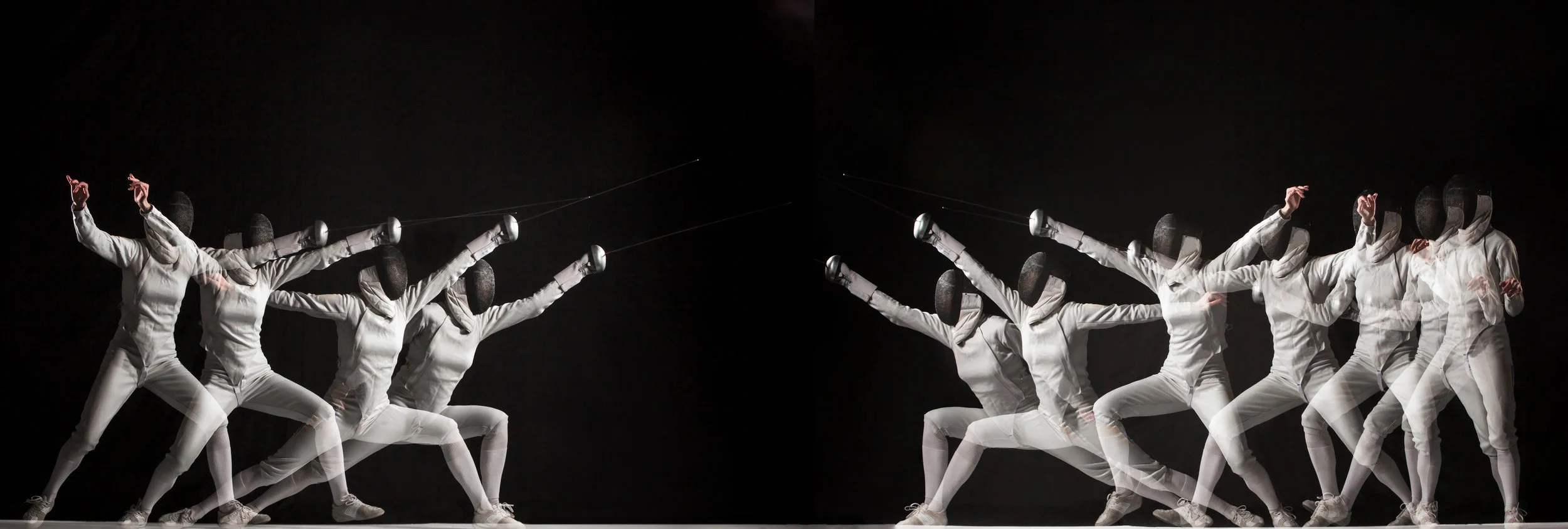
Olympic Sport Fencing is a tactical sport requiring agility, balance, and quick reflexes, often compared to a "physical game of chess" due to the mental strategies involved. Fencing involves two competitors who use simulated sport “swords” to attack and defend against each other, aiming to score points by hitting designated areas on their opponent's body with their weapon. In modern life, publicly carrying a sword - or even needing one for self defense - is impractical (and in many areas, illegal). For this reason, fencing has evolved from its combative origins into a sport. As such, the journey of learning to fence is really about self improvement. Fencing works to improve coordination and balance, focus, strength and endurance (mental and physical), dynamic problem solving, discipline, respect, and self-confidence. Fencing is great for stress-relief; almost nobody leaves not smiling after a few bouts.
Regardless of your own personal goals for fencing the coaches at SMF are ready to give you the guidance that you need.
Are there different types of fencing?
Yes.
Using the term “fencing” broadly to refer to any simulated sword interaction there exists several different categories, such as Historical European Martial Arts (HEMA), kendo (the Japanese art of practicing wielding a katana with a bamboo shinai), light saber, Modern Olympic Sport Fencing, as well as many others. HEMA tends to focus more upon the practical use of a weapon as would be required for self defense or combat, whereas Olympic Fencing tends to focus more on the sport that evolved from combative sword practice as the need to use such and implement to protect ones self fell out of favor. Olympic Fencing focuses upon the setup, timing, and distance control required to exploit one’s opponent's vulnerabilities, be it an over commitment, being unprepared, or a tactical mistake. To do this requires a high level of focus and self-control.
Within the world of Olympic Fencing there are three distinct weapons; the epee, the saber, and the foil - each with historical origins tied to actual swords. Each weapon within fencing has its own unique target area (epee = whole body, saber = from the waist up, foil = torso only), its own way that the target can be struck (saber = cut with the blade edge or thrust with the blade end/tip, epee and foil = only thrusts with the blade end/tip), and its own minor variations to the general governing rules. In addition to designation between weapons, fencing can also be performed individually or in a team format. At the club and local level, both men and women can sometimes compete against each other, but at the higher levels, the genders are separated.
The epee that is used today resembles the historical training tool used to safely teach students to wield a dueling sword, such as an epee de combat or a basket hilt rapier (think of the swords carried in most movies). With its dueling historical roots, the epee is primarily defensive based, and prioritizes patience and precision so that the victor can make a quick first touch. The epee is the heaviest and stiffest of the three weapons and is easily recognized by its large bell shaped hand guard. Click here to see the gold medal bout from the 2024 Olympics in Paris for men’s team epee as an example of epee fencing.
The saber resembles the historical training tool used to safely teach students to wield a military saber or cutlass (a “pirate sword”). Saber prioritizes quick decision making and taking the initiative, and as a result is characterized by quick actions with a heavy reliance upon attacks. Saber is also the only of the three weapons that allows for touches to be scored through contact with the blade sides (a cut), which adds a greater amount of 3 dimensionality to the exchanges. The saber is the shortest of the three weapons and is characterized by the curved, C-shaped guard. Competitive sabers also differ from competitive epees and foils due to their simplicity; having no electrical wires or buttons. Click here to see the gold medal bout from the 2024 Olympics in Paris for men’s individual saber as an example of saber fencing.
The foil resembles the historical training tool used to safely teach students to wield a short sword - the gentleman’s or court sword, that was carried by nobles for self defense and fashion. Foil can be thought of as the middle ground between epee and saber; there are quick attacks, but practitioners need to be ready to defend at any moment. Successful foilists rely upon precision footwork and balanced posture to set up and execute their offensive and defensive actions. The foil is as long as an epee, but is much more slender in shape (making it more flexible, like a sport saber). The foil has a small dish shaped guard at the base of the blade to provide minor hand protection. The historical reason for the small guard is to teach practitioners to rely upon the blade actions for protection of the body, not a guard. Click here to see the gold medal bout from the 2024 Olympics in Pars for women’s individual foil as an example of foil fencing.
Which weapon is right for you? That is a very difficult question to answer and one that only you can really answer for yourself. SMF is proud to be a three weapon club; offering instructional classes and open practice times for all three weapons. After completing the fundamentals of fencing, we encourage all of our students to explore the different weapons to figure out which one brings you the most enjoyment. Or, why stop at only one?
When I watch fencing on TV or the Internet it looks very easy, is it?
When fencing is televised it is typically only for the Olympics. Many of the bouts that are posted to the most popular YouTube sites are of the top tier international fencers competing at the highest level of international events. What you are seeing is the equivalent of watching an NFL, MLB, or NHL playoff game. Similar to professional sports, top tier athletes make their craft look fast, smooth, and effortless. Someone beginning football certainly would not expect to perform like an MVP, such as Tom Brady - or Wane Gretzky for hockey or Michael Jordan for basketball. Fencing is no different; it is an Olympic sport not because it is necessarily easy but because it takes years of dedicated practice (and a touch of luck) to obtain the required reflexes and skills necessary to consistently perform at the required level.
However, beginning fencing is not hard. All that is required is an open mind and a willingness to learn. Fencing competitions tend to be divided up into age and skill categories (ratings) to make space for developing fencers to grow within the confines of a reasonable set of challenges. The individual techniques of fencing aren’t overly complicated nor do they require a great deal of coordination in order to execute them at a basic level. The coaches at SMF have the experience and knowledge to adapt any move to accommodate most physical limitations. Through dedicated practice, any fencer will eventually gain the skill to proficiently execute a sequence of moves effortlessly and smoothly. If properly focused in class, it won’t be long before you are impressed with how effortlessly you can score touches!
Is fencing just for kids?
Most definitely not!
Fencing is an activity that can be enjoyed by anyone of any age (7 - 99+). Fencing, domestically and internationally, has age categories and competitions ranging from 7 and 8 year olds all the way up to 80+ year olds. Since fencing is a sport that simultaneously employs both the mind and the body, adults and youths are also able to remain competitive against each other; each brining their own unique strengths to the strip.
Most fencing studios will start children around the age of 7. This is mostly because muscle and coordination development will be adequate to hold the equipment and perform the techniques. Additionally, maturity and concentration have developed sufficiently to permit the remembering and following of the safety rules and maintain focus all the way to the end of a class.
Fencing is a great activity for adults; not only does it keep the body active, it is a refreshing change of focus from what most are required to do throughout the rest of their day. The ability to stab something with a weapon is also a surprising stress reliever. Since their are adult specific competitive age categories, there is room for adults who did not start fencing as children to develop and enjoy the sport as well. SMF has a large adult fencing population.
Fencing is also one of the rare activities that parents are able to participate in with their children.
What is required to start fencing?
To start fencing at SMF, we only require appropriate athletic attire (no shorts or sandals) and an adventurous attitude. We will provide everything fencing specific that is required for the beginner classes.
As students progress and demonstrate their interest and commitment to the sport, they are encouraged to start purchasing their own equipment. The coaches at SMF encourage students begin with purchasing their own mask and glove as these are the two pieces of equipment that make the most personal contact with the fencer.
Is fencing right for me?
Of course! Fencing can be for anyone that has an interest in learning about the sport.
Unlike some other sports, fencing does not have an ideal body type. At its core, fencing is about discipline, focus, self control, and real time problem solving (making immediate decisions with limited information and then adjusting the course of action as more information becomes available). Fencers learn to use their personal strengths to their advantage and to identify and exploit their opponent’s weaknesses. Therefore, a fencer can be tall or short, fast or slow, wide or narrow, young or experienced, male or female. The balance of fencing is that every strength, technique, or opportunity comes with a consequence and a shortcoming. A quick look at the participants at any sizable fencing competition reveals that this sport can be enjoyed by just about anybody.
At SMF our coaches are happy to work with anyone; an athletically gifted youth or a retiree that has never participated in a physical activity - and everyone in between. Fencing is a personal journey; SMF is here to guide you along your own path - whether that is to become a National Champion or to just to maintain a healthy lifestyle.
Is Fencing Expensive?
Not necessarily.
Classes at SMF are competitively priced to other activities in the area. The cost of a beginning set of fencing equipment is comparable to other sports, such as hockey or football. Fencing may require more equipment than other sports, but the total cost for the equipment is similar. At SMF we work to spread the equipment purchases out by loaning club gear until the need and/or interest has been established and by increasing the amount of necessary gear as the student’s skill level progresses.
Obviously, as with any activity, there are many gear options ranging from the budget friendly all of the way up to the custom tailored. Fencers are no different than anybody else; for those that desire, you are more than welcome to build a collection of gear that rivals the warehouses of the gear suppliers. However, recreational fencers are able to participate in regular classes with the bare minimum of equipment. Competitive fencing does require a few more pieces of kit in order to participate in sanctioned events, but there is no requirement to exceed the required minimums. The key driver is safety; having the right equipment to keep all participants safe for the event at hand.
Is Fencing Safe?
Yes!
Despite its combative roots and rigorous dynamic athletic movements, sport fencing is often considered one of the safest sports and the safest of the combative sports/martial arts. With an injury rate of around 2.5%, fencing is one of the safest of all of the Olympic sports - including events such as swimming, table tennis, and badminton. In 2026 USA Fencing, the governing body of Olympic fencing within the United States, concluded a 6 year study to verify the long held belief that fencing is one of the safest sports available. The most common injuries experienced while learning to fence are the occasional bruise or a sore muscle. In order to maintain the safety of the participants, the importance of proper technique and safe practices are imposed upon the students at SMF from day one.
Are there any college scholarship opportunities available through fencing?
Yes, but…
While a select few exceptional fencers are offered full-ride college scholarships, this is far from the the norm. There is a common misconception that because fencing can be considered an obscure sport it is easier to get a college scholarship through it. In reality, because fencing is less popular than sports such as basketball, football, baseball, softball, or soccer there are significantly fewer schools with fencing scholarship programs. Additionally, the few colleges with proper NCAA fencing programs typically have fewer scholarship positions to be give out than team sports. As a result, on a percentage basis, most students have a greater chance of gaining a scholarship in a more mainstream sport than fencing. Earning a NCAA Div 1 scholarship requires a willingness to regularly travel to competitions all over the United States and to consistently place well.
That said, many more colleges offer NCAA Div 3 fencing programs. While these programs may lack the prestige of a top tier program or the funding to provide a full ride scholarship, there are many more positions available. Additionally, many of these programs accept/recruit fencers of lower ratings (skill levels) than the Nation’s most elite (i.e. Olympic hopefuls). This route is an excellent opportunity to be compete as a collegiate athlete while still maintaining a primary focus upon studies.
If your chosen college does not offer fencing as a competitive sport, it might still have a fencing club. While no scholarships are typically associated with a club, it is an excellent way to engage with others with a similar interest, to stay active, and to work out some stress after a difficult exam, lab, or homework assignment. Many college clubs host local events and may even travel to compete against other college clubs. This is a fun way to remain an active fencer while away studying.
Even if you aren’t lucky enough to be granted a scholarship for fencing, by just participating in the sport you are increasing your chances of success later on in life. Studies have shown that fencers are routinely amongst the student-athletes with the highest GPAs.
Have additional questions?
Do you have a question that wasn’t addressed here? Excited to learn more? Eager to sign up for lessons?
USA Fencing (the governing body of Olympic Sport Fencing within the United States) has a fencing overview webpage, linked here. Or, feel free to reach out to us by emailing us at SMF@smokeymountainfencing.com or giving us a call at (865) 236-0702. We’d love to hear from you to discuss how fencing might be the activity that you’ve been looking for.
Ready to jump in and start learning out to fence? Click the button below to learn about how to sign up classes.